Looking for the Best Mind Mapping Tools
10.28.07I'm a very recent convert to the belief that mind mapping tools can be valuable. After years of sneering at them as vague and superflous (without ever really trying them) I did a one hour consulting gig with the folks over at Imindi a week or so ago.
Now I am hesitant to think about anything without the ability to "write it down" in a mind map. The ability to document the free flow of connected thoughts is just too seductive to pass up when thinking through complex proccesses.
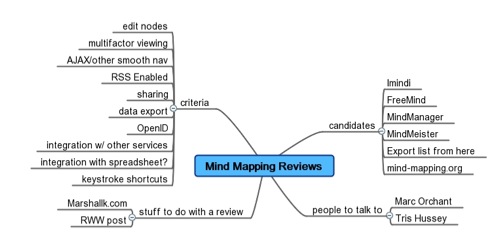
I could use some help figuring out what the best mind mapping service is, though. Here's my criteria so far - above in an image from MindMeister (which is AWESOME so far). Can you suggest anything I'm missing or favorite tools I should evaluate?
Imindi isn't doing it for me yet. It's an alpha level service that should be substantially improved when the team is able to make some updates, but for now I want to find something that works better for me. Imindi is cool because it's going to be really social, it publishes RSS feeds, supports OpenID and includes Del.icio.us integration. The ability to embed a live map in an iframe is neat but it would be nice if it were a Flash widget that scaled or if I could scroll in this iframe (can't figure that out). There's a whole lot more that they are working on as well, the back end is striking, it's largely the front end that's not usable enough for me right now.
It doesn't allow for data export, though. That's a deal breaker. Navigation and color differentiation between levels and types of relationships is weak, I want some AJAX where there isn't any yet, the pagination for nodes with more than 6 connections is annoying, etc. Also, just in order to make a more informed decision (and to make a blog post about it on Read/WriteWeb) I want to evaluate some other mind mapping tools. First stop, http://del.icio.us/popular/mindmap
If you'd like to make any suggestions for important criteria or mind mapping tools that might meet these criteria - I'll follow up here on what I figure out.


October 28th, 2007 at
I collect details of information mapping and info management tools. These are all web-based applications that do mind mapping, concept mapping or diagramming with mind maps faciliation.
Information mapping . . . . . . . . . . . .
bubbl.us Collaborative mind mapping (radiant format not enforced)
comapping.com Collaborative (but, for people who like free-format mind mapping, rigid) left-to-right mind mapping
glinkr.net Concept mapping and mind mapping (shared but not collaborative)
imindi you mentioned (it’s much too limited in what it shows for my taste)
mindmaps.kayuda.com Collaborative mind mapping and concept mapping
mappio.com Unusual mind mapper where the user edits indented text to change the mind map
mapul.com Collaborative mind mapping with an organic flavour
mind42.com Collaborative mind mapping
mindmeister.com Collaborative mind mapping
mindomo.com Collaborative mind mapping
wikimindmap.org Make mind maps from WikiMedia articles (not quite what you want but so interesting I had to include it)
wisemapping.com Collaborative mind mapping
webofweb.net Collaborative mind mapping
Generic diagramming . . . . . . . . . . . .
cumulatelabs.com/cumulatedraw/ Collaborative diagramming – can draw mind maps and concept maps
flowchart.com Collaborative diagramming – can draw mind maps and concept maps
gliffy.com Collaborative diagramming – can draw mind maps and concept maps
thinkature.com Collaborative on-line whiteboard service - can draw mind maps and concept maps
If you want desktop-based mind mapping, you’ll have to go to mind-mapping.org, and in the tab ‘Refine software list’, pick your OS and select the mind mapping category. That gives 80 at present for all OSs.
Regards
Vic
http://www.mind-mapping.org
The master list of mind mapping &
information management software
October 28th, 2007 at
Vic, you are a hero - thank you very much.
October 28th, 2007 at
Hi Marshall, Yes Mind Mapping tends to grow on you! You are absolutely right about the front end of Imindi. We are working hard to change that. Most of the power of Imindi is the “Thought Engine” that lies behind the Mind Map interface which literally enables you to create your own personal/group Think Tank - a semantic connected thought network which are linked to relevant knowledge in your documents by specially marked up links. See the following “Essay” composed on Imindi for an example: http://www.imindi.com/users/Adam/pages/87
Although, like I said we are going to drastically improve our UI in the next few weeks - Mindmeister and the like are not really our competition - indeed I can forsee the day when you will be able to use any Mind Mapping tool to input your thoughts into the Imindi Thought Engine. Our number one competition is Twine who are taking a different approach to personal/group based knowledge management. Also as far as data portability is concerned our intention is to not only ensure that you can export your data to other web and desk top based Mind Map Apps but also ultimately to take this much further by encoding all data in semantic web standard compliant formats which will ultimately mean that all Imindi users will be able to export their data to and from all your favourite semantic data applications. Hope this helps!
October 28th, 2007 at
Hi Marshal, I have used freemind (# 3 on del.icio.us list) and found it very user friendly. Don’t know about adaptability to online use though…
One useful feature that I would suggest, is the equivalent of the ‘Format Painter’ in Excel (the little brush), which allows one to copy the formatting across cells. To have something similar for nodules in mind map will be very convenient.
Cheers, M
October 28th, 2007 at
Thanks for the follow-up, Adam.
Michael, I like that suggestion quite a bit. I wonder if the mming web apps are any where as data rich as the desktop ones.
October 29th, 2007 at
Pleasure Marshall. To show you another neat thing about Imindi, I copied the Thoughts in your Imindi Mind Map into the one that I had created on “Making Imindi Better”. This is part of a group Think Tank on Imindi Inc. Your Thoughts are seamlessly merged into my map and but your authorship is retained and your ranking on Imindi is boosted. Thus, the thought engine, rewards individual original thought whilst also leverages the power of the social network effect. Note Imindi has 3 privacy levels: totally private/Like minded colleagues/completely public. Your map was public which is why I was able to merge it into my own.
October 29th, 2007 at
Oops forgot the link:
http://imindi.com/journeys/472-make-imindi-better/maps/3197959-mind-mapping-criteria
October 29th, 2007 at
Marshall,
I’ve used (and reviewed) FreeMind, and like it well enough, although it definitely needs some polish and the project doesn’t have a lot of activity.
I’ve been demo’ing Curio and am really liking it. It’s a bit more multi-purpose than just a mindmap, but all the tools are geared around brainstorming / putting down variable types of info fast.
October 30th, 2007 at
I’ve been interested in mind mapping for a fair while but never really got on with the software. Intrigued by the first comment I went to www.mind-mapping-org . It’s a great site. There I found Cayra. First impressions - it’s a thing of beauty
I blogged about it here. Thanks for all the leads.
October 30th, 2007 at
Hi Marshall,
If you are looking for a more dynamic mapping mind product try PersonalBrain. We have both free and trial pro editions. PersonalBrain organizes information as Thoughts. It is very different from 2 dimensional mind maps because clicking on a topic triggers all related nodes and the display is always relative to your current selection. (We can discuss further the differences between purely hierarchical and network displays.) Download it off our site at http://www.thebrain.com/download
You can also check out my blog on PersonalBrain at http://personalbrain101.blogspot.com/ for tips and tricks on getting started.
Any of your going to KMWorld in San Jose next week?
October 31st, 2007 at
[…] Other presenters I hope to find a second with include (In no order as the last entry, a guy I totally dig, will prove) Debbie Weil, Mike Arrington, Brian Clark, Rohit Bhargava, Andy Beal, Maggie Koran Fox, Vanessa Fox, Paul Gillin, Shel Israel, Marshall Kirkpatrick, Aaron Wall and Brian Solis. […]
November 12th, 2007 at
I’ll also vote for Cayra.
As it often happens with brainstorming and thoughts mapping, it’s important to look at your ideas from a different angle. Cayra lets us do that - whichever node you click on, smoothly moves into the center of the map, so that you can focus on this idea and see all its connections without other irrelevant (at the moment) topics getting in the way.
What concerns intergration - right now you can work with map created in MindManager and FreeMind.
Also as it is written on their web-site, Cayra developers are planning to intergrate Cayra with MS Office.
Plus, it’s possible to save you map in HTML format and as an image (JPG & BMP).
Lots of useful shortcuts are also available (all the usual - Ctrl+Z and other “Ctrls”, Insert, Enter, Tab..) so that you can manage the map entirely from the keyboard.
May 1st, 2008 at
Marshall: I’ve been testing about a dozen different desktop and web-based mind mapping tools and have a giant review almost finished. I’ve actually spent a full year testing these apps. My conclusions so far:
(1) For desktop and general all around mature product: Mindjet.com’s MindManager. Incredibly productive tool.
(2) Freemind is a great freebie desktop app to start with.
(3) For web-based, I’m undecided, but on my short list are mindomo.com, mindmeister.com, and Comapping.com. The latter is real-time collaborative, unlike most other web-based mind mapping tools.
May 5th, 2008 at
What i found to be way more fun, viral, and potentially more effective (at gathering data across many human minds) is this: http://www.humanbraincloud.com/ - betcha cant’s stop playing once you start!
No, it’s not a place to store your personal thought bubbles, but it certainly is effective at gathering and displaying the almost Pavlovian associations people have with words and concepts.